A customer asks, "How much to clean my yard?" You ask how many dogs they have. They say two. You send your normal weekly price.
Only later do you learn that nobody has cleaned the yard since last season.
Dog count matters, but it is not enough to price a first cleanup. The first visit is a separate job with its own uncertainty. Treat it that way in the quote, the schedule, and the billing, then make the ongoing service easy to understand.
Ask about the condition, not just the dogs
Start with the questions that change the work. How large is the area you are expected to clean? When was it last picked up? How many dogs use it? Is the waste visible, or is it buried in long grass and leaves?
Ask whether there is safe access, whether the dogs will be secured, and where the service area begins and ends. A front lawn, fenced backyard, and side run are not automatically one small yard just because they share an address.
Photos can help qualify the job, but a photo is still a limited view. Leave room in the quote process to clarify significant differences before work begins. If your service has limits around unsafe conditions or prohibited materials, explain those limits before sending someone out.
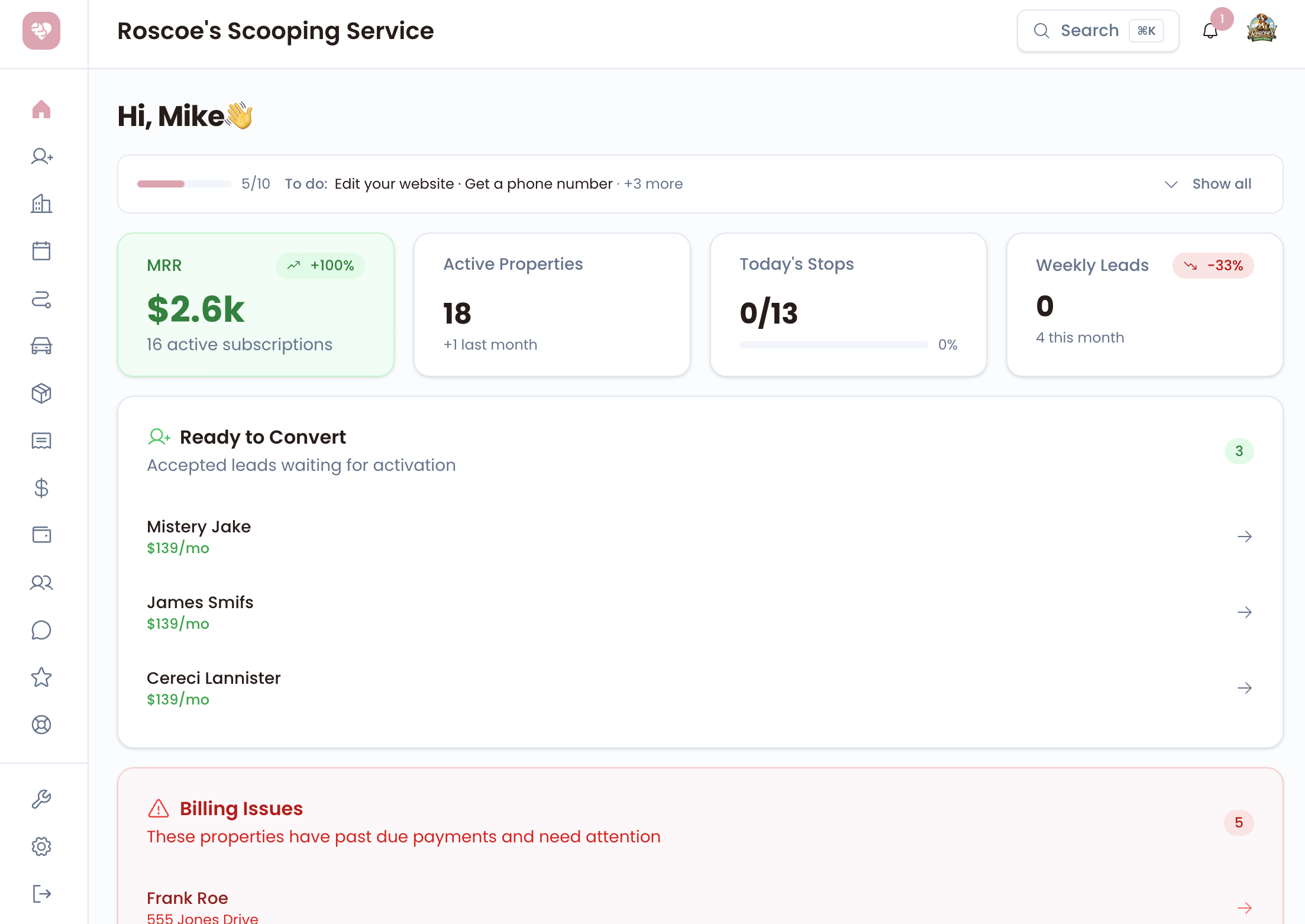
In Scoopify: Customers can get their own quote through the included website or an embedded quote form on an existing site. Keep your pricing rules and follow-up process aligned with what the form can establish. An instant quote is useful; it should not promise certainty about conditions the customer has not described.
Build a price from time and cost
Start with your own cost of doing the job. Estimate labor, travel, disposal, supplies, and the overhead the visit needs to support. Include a reasonable allowance for uncertainty rather than assuming everything will be easy.
Here is a simplified example to show the method, not a recommended market price:
| Component | Illustrative amount |
|---|---|
| 75 minutes of labor at a $40 hourly labor budget | $50 |
| Allocated travel and vehicle cost | $12 |
| Supplies and disposal allocation | $8 |
| Estimated direct cost | $70 |
At a $100 selling price, that leaves $30 before any costs missing from the example. It is a 30% margin on the selling price, not a 30% markup on cost. If the work actually takes two hours, your labor estimate changes and so does the result.
Your labor budget should not disappear just because you own the business and do the work yourself. Owner time is still part of the decision. Build the number with your actual costs using the pricing calculator, then compare it with the work customers in your area are asking you to do.
Choose a quoting method you can explain
A fixed first-clean price works best when you can define what it covers. You might use clearly described condition bands or qualify the property individually. Another option is a time-based quote with a minimum and a stated approval process for additional time.
Whichever method you choose, write down the boundary. "Initial cleanup for the described backyard conditions" is more useful when the description states the area, buildup, and access assumptions. "We'll see when we get there" is not a reassuring pricing policy.
If the job turns out to be materially different, pause and seek approval under your terms before doing additional chargeable work. Do not use the initial-cleanup fee as a vague permission slip for any amount you decide afterward.
Keep the first charge separate from the recurring offer
Show the customer two lines: the initial cleanup and the ongoing service. Then show when each is charged and when the regular service begins.
For example: "$100 initial cleanup for the conditions described, followed by $100 per month for the agreed weekly service plan." Those amounts are illustrations, not suggested rates. Add your actual service terms, start date, and any approved extras so there is no confusion over what the first payment covers.
Do not imply that monthly and per-visit pricing are interchangeable. A recurring monthly plan needs clear rules for the service arrangement, including holidays, weather, and cancellations. The customer billing guide walks through that distinction.
In Scoopify: Initial-clean charges and recurring service subscriptions can be managed as separate parts of the same customer relationship. Configure the amounts and billing start dates to match the offer, rather than trying to make one recurring charge explain two different jobs.
Schedule the first visit like a first visit
An initial cleanup needs a larger time allowance than a maintained stop when the conditions call for it. Do not fill the whole route with routine work and then add an uncertain cleanup into the only remaining fifteen-minute gap.
Try to schedule the job near a service area you already work. If the customer is outside your normal area, account for that trip rather than assuming the recurring route will absorb it later.
Give the technician the relevant notes: which areas are included, what conditions were described, how access works, and what to do if the scope has changed. A clear quote is not much help if the person doing the work cannot see the useful details.
Read the route planning guide for a manual way to budget service time and travel before adding the appointment.
Confirm the result and set up the next visit
Record that the visit was completed and note any issue that matters for the next stop. Update stale access instructions or service-area details while the information is fresh.
Then confirm the recurring arrangement: day, frequency, start date, and billing setup. Do not leave a customer who has agreed to weekly service in a one-time-cleanup limbo because nobody moved the relationship forward.
If the yard needs a different ongoing price than originally discussed, explain the reason and get agreement before changing the charge. Consistency is useful, but a consistently unclear bill is still a problem.
Quote the work you are actually agreeing to do
The first cleanup sets the tone for the relationship. A good quote does not need a clever sales trick. It needs enough information to price the work, a clear limit on what is included, and a simple explanation of what comes next.
You can run that process with a form, a written quote, a calendar, and invoices. Scoopify puts quoting, property notes, scheduling, and billing closer together so you do not have to re-enter the same customer at every step. Explore the workflow, check the available plans, or use the quote template builder to work on the wording first.